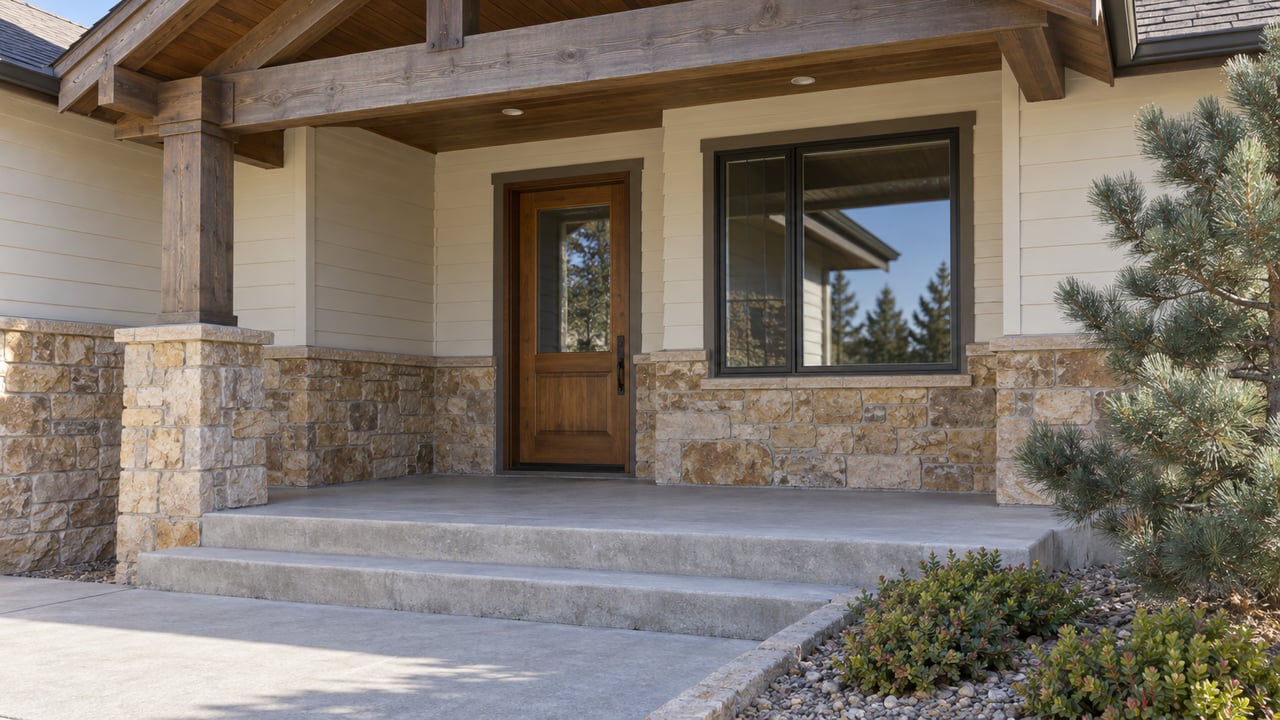
Castle Rock's New Water Fee Counts the Basement, and That Decides Who Saves
"We finally had the data to study what these new houses look like and what they are really using in terms of water," Castle Rock Water Director Mark Marlowe told Colorado Politics in April. That data led to a new rule. Since July 1, 2026, the Town's ordinance has charged water, renewable water, and wastewater system development fees on new single-family and two-family homes based on gross floor area. The fees are collected when the builder submits a complete building permit application.
Gross floor area has a specific meaning in the ordinance. It includes basements and all other enclosed, roofed space. It leaves out garages, open balconies, decks, and patios. Take a 1,900-square-foot ranch built over a 1,900-square-foot unfinished basement. The fee schedule treats it as a 3,800-square-foot home, and that one detail decides which new Castle Rock homes actually got cheaper.
Builders pay these fees long before a buyer shows up, so they never appear as a line item at closing. They sit inside the price of the house. Before July 1, the 2026 fee schedule listed a flat combined total of $51,890 for a standard new home on a 3/4-inch meter: $9,931 for the water system, $35,829 for renewable water, and $6,130 for wastewater.
The fees are not small within the overall cost of building. At the April hearing, Morgan Cullen of the Home Builders Association of Metro Denver said development-related costs for a new single-family home in Castle Rock likely top $100,000, about 15% of a home's final price. He added, "Castle Rock today has the highest impact fees of any local government in the Denver metro area." Water fees are one piece of that total. Of all the pieces, they are the one that just changed.
Town Council approved the ordinance 6–0 on first reading April 21, 2026, and passed it on second reading May 5.
The Town staff report sets out the new schedule in 500-square-foot tiers. The table below compares selected tiers with the old flat charge. The comparison column is simple subtraction from the old $51,890.
| Gross floor area, basement included | Combined fee since July 1, 2026 | Change vs. old $51,890 |
|---|---|---|
| 1,500 to 1,999 sq ft | $21,750.30 | about $30,140 less |
| 2,000 to 2,499 sq ft | $33,868.32 | about $18,020 less |
| 2,500 to 2,999 sq ft | $42,257.72 | about $9,630 less |
| 3,500 to 3,999 sq ft | $42,879.16 | about $9,010 less |
| 5,000 to 5,499 sq ft | $48,161.38 | about $3,730 less |
| 5,500 to 5,999 sq ft | $51,890.00 | no change |
| 7,500 to 7,999 sq ft | $59,657.96 | about $7,770 more |
Two features of the table matter for buyers. The first is the step at 2,000 square feet. Going from the 1,500 to 1,999 tier to the 2,000 to 2,499 tier adds $12,118.02, a jump of roughly 56%. Above that, the curve nearly flattens. Every tier from 3,000 to 4,499 square feet lands within about $1,600 of the others.
The second is the anchor point. Staff set one "single family equivalent," the unit that equals the full old fee, at the 75th percentile of home sizes built since 2023, which works out to 5,500 to 5,999 square feet. Every home smaller than that pays less than before. How much less depends heavily on which side of 2,000 it falls.
Staff built the schedule from water use at 750 single-family homes built between 2023 and 2025. All of them were built under the Town's 2022 landscape standards, which call for Coloradoscape front yards and limit irrigated turf in back. Homes from 1,500 to 1,999 square feet averaged about 70 gallons per day. The average across the whole sample was about 152.
The tier just above that is where the data runs thin. The raw average for 2,000 to 2,499 square feet came out to 221 gallons per day, which is higher than every larger size group in the study. The staff report explains that the number came from "a very small sample size of three homes" and calls it "statistically unreliable." Staff replaced it with a value interpolated from the neighboring tiers. The final schedule assigns that tier 109 gallons per day.
That is sound practice for a number with almost no data behind it. It also explains the size of the step. The $12,118 jump between a 1,999-square-foot home and a 2,000-square-foot one comes from a curve drawn across a gap, because Castle Rock builds very few homes in that range. The staff report says smaller homes represent "a much smaller share of construction."
The same report shows where construction is concentrated. More than 55% of the homes studied fell between 3,000 and 5,500 square feet. In that range, the new fees run from $42,568.44 to $48,161.38, roughly $3,700 to $9,300 below the old charge.
The basement rule pushes many modest-looking homes into that band. Put a 1,900-square-foot main level over an equal unfinished basement, and the fee comes to $42,879.16. The same home on a slab would pay $21,750.30. The basement accounts for the $21,128.86 difference. One early news account described the fee as tied to "finished square footage." The adopted ordinance and the staff table use gross floor area, and the table's heading reads "Total SF including unfinished basement." The ordinance is the version that controls.
Across the whole study sample, staff projected that 554 homes would have paid less under the new method, 129 more, and 67 the same. They also projected about 10% less fee revenue overall. Marlowe put that figure at roughly $4 million. One break went away earlier in the year. From 2023 through 2025, builders who installed front and back landscaping received a fee credit. The Town ended it on January 1, 2026, after finding no measurable difference in water use.
The policy is supposed to change behavior, and its own supporters disagree on whether it will. Mayor Jason Gray said, "If it incentives builders to do smaller homes, that hopefully allows first-time home owners to get into the market a little easier." The Douglas County News-Press reported that Councilmember Laura Cavey asked whether the fees might encourage smaller "cookie-cutter" homes. Marlowe answered that the market would more likely decide what gets built.
Dawson Trails is the place to watch, because nearly all of its homes will be permitted under the new schedule. Taylor Morrison has bought home lots there. On July 7, Town Council approved a 100-unit townhome plan, and planned areas nearby are described for 484, 229, and 256 detached homes. The ordinance's size-based schedule covers one-family and two-family dwellings as the Town code defines them. Buyers looking at townhomes should confirm with the builder which schedule applied. Access is coming together too. The first northbound I-25 on-ramp at the Crystal Valley Parkway roundabout opened June 12, 2026, and the southbound ramps are scheduled for 2027. The Costco planned at Dawson Trails is expected to open in 2027, depending on the interchange.
Castle Rock's proposed 2027 budget, dated September 15, 2026, calls for a 4% to 5% increase in water rates and fees for existing customers and an increase in growth-related water resources fees. Adding up the proposed components, the 1,500 to 1,999 tier would rise to about $23,975 and the 2,000 to 2,499 tier to about $37,105. These are proposals. First reading is set for October 6 and second reading for October 20. Because fees are locked in when the complete permit application is filed, a home permitted in late 2026 and one permitted in 2027 could carry different charges.
Market conditions make these questions easier to ask. DMAR's September 2026 report, released October 3, shows 4.76 months of inventory across metro Denver and 30-year rates near 7.5% by the end of September. Amanda Snitker of DMAR said rate buydowns and seller-paid concessions "are all on the negotiating table right now." Those are metro-wide figures, not Castle Rock-specific ones. On a new build inside Castle Rock Water's service area, ask:
None of this applies to resale homes, which paid their fees when they were built.
Do I pay this fee at closing? No. The builder pays it when the building permit application is filed. Any effect on you comes through the price of the home.
Does a garage or deck count toward gross floor area? No. Garages, open balconies, decks, and patios are excluded. Basements count whether or not they are finished.
Is the 2027 increase final? Not as of October 4, 2026. Council readings are scheduled for October 6 and October 20.
If you're weighing a new build in Castle Rock against a resale home, a few minutes with the permit date and gross floor area can tell you what's built into the price. Bring us the floor plan, and Pinette Realty Group will help you work out where the house falls on the fee schedule and what to ask the builder.
This article is general information, not legal, tax or financial advice. Consult a qualified professional about your situation.
Stay up to date on the latest real estate trends.
We pride ourselves in providing personalized solutions that bring our clients closer to their dream properties and enhance their long-term wealth.
Get In Touch With Our Team To Learn More
8955 RIDGELINE BLVD STE 1400 HIGHLANDS RANCH CO 80129