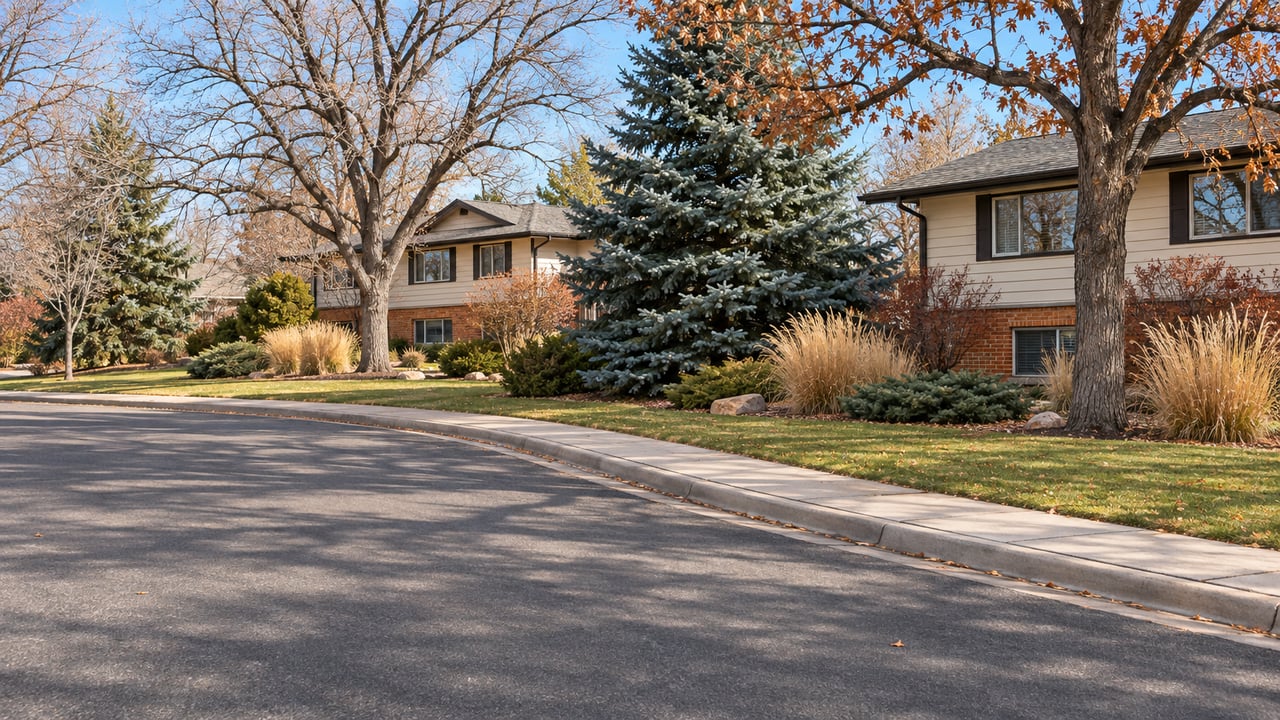
Centennial Said No to a Road Tax. So Who Pays for the Streets Now?
Most Centennial property tax bills carry a city line of 4.982 mills. On some bills, a second local line appears beneath it. Buyers usually spot it during the title review or the first tax-bill check. It comes from one of five General Improvement Districts, small districts whose residents pay their own property tax levy to maintain things the city does not pay for on its own. In one of them, that levy is about four times the city's.
That extra line is the small-scale version of the question Centennial voters answered on Nov. 3: who pays to keep the streets, fences and sidewalks of a low-tax city in good repair?
Centennial has five city-controlled General Improvement Districts: Antelope, Cherry Park, Foxridge, Walnut Hills and Willow Creek. Each has its own property tax levy and its own budget, kept separate from city funds, with the City Council serving as each district's board.
Here are their levies for tax year 2025, budget year 2026, from the Arapahoe County mill levy filing:
| District | Levy, tax year 2025 | What the filing and city budget show |
|---|---|---|
| Antelope Water System GID | 20.754 mills | 0.754 mills for operations, 20 mills for bond payments |
| Willow Creek 1 & 2 | 5.948 mills | Operations and bonds |
| Foxridge | 4.864 mills | 1.920 mills for operations, 2.944 mills for bonds |
| Cherry Park | 4.437 mills | Operations |
| Walnut Hills | 2.404 mills | Operations |
This money pays for real work. When council reviewed the district budgets in October 2026, Cherry Park's fence overhaul was described as nearly finished. Walnut Hills plans to spend savings it has built up. Its proposed 2027 grounds maintenance budget is $851,900, compared with $50,000 projected for 2026, and that October coverage tied the money to fence replacement. The Walnut Hills levy for tax year 2025 remains 2.404 mills.
These districts show one way to pay for upkeep: the people who use a fence or water system fund it directly through their tax bill. Ballot Issue 2A would have funded the citywide street network a different way.
Ballot Issue 2A would have raised Centennial's sales and use tax by one percentage point, from 2.5% to 3.5%, starting Jan. 1, 2027. According to the Arapahoe County sample ballot, that would have raised $27 million a year for street maintenance, pothole repair, bridges, sidewalks and related work. Unofficial results reported by the Centennial Citizen on election night showed 40.74% yes and 59.26% no. The results are official once Arapahoe County certifies them.
The supporting campaign, Keep Centennial Moving, argued that dedicated money would close the maintenance gap and keep the city on a pay-as-you-go basis. The opposing site, Smart Centennial, argued the increase would hurt affordability, permanently tie revenue to streets, and was unnecessary given the city's reported surpluses. In Denver7's pre-election coverage, city founder John Brackney called it "a 40% sales tax increase." He suggested annexing nearby unincorporated commercial areas as another source of revenue.
According to Denver7, Centennial is still debt-free and has not changed its sales tax rate since 2003. The gap that 2A was meant to close comes from how the city set up its street funding.
Centennial's sales tax is its biggest revenue source. In the 2026 budget it brings in about $52 million of an $87.1 million General Fund, roughly 60%. Only a fixed $2.8 million of it goes to streets, an amount set by voter-approved ballot question 2G in 2003. The amount doesn't change when sales tax revenue goes up or down.
The rest of the Street Fund's regular income comes from sources that also barely move. In the city's proposed 2027 budget:
| Street Fund source, 2027 proposed | Amount |
|---|---|
| Motor vehicle use tax | $6.85 million |
| Highway Users Tax Fund, from the state | $4.15 million |
| Sales tax under question 2G | $2.8 million |
| Road and bridge shareback | $560,000 |
| Pavement restoration fees | $35,000 |
That is about $15 million a year in dedicated revenue. The city says maintaining and operating the transportation system takes at least $35 million a year, and it has covered the difference with General Fund surpluses and reserves. The 2027 proposal shows how much those transfers matter. It moves $37.45 million from the General Fund into streets and also counts on $25.72 million in state grants, an unusually large one-year amount. The Street Fund's beginning balance falls from $71.4 million in 2026 to $60.9 million in 2027 and $57.9 million in 2028. The city's budget site projects that by 2028, existing resources will no longer cover regular infrastructure costs.
The gap is widening because the stores that once generated much of that sales tax are closing. Mayor Christine Sweetland told Denver7 in August that revenues "are just flattening," adding: "Those big box stores that were here when Centennial was founded, you know, Best Buy, Macy's, Sears — they've gone away."
The Streets at SouthGlenn shows what is planned in their place. According to the city's project page, Alliance Residential has proposed a five-story, 358-unit apartment building on the former Macy's site, and the application is in planning review. The owner of the former Sears site is marketing it for residential redevelopment, and no application has been filed for that site. Separately, The Luzzatto Company bought about 100,000 square feet of retail at SouthGlenn, including space leased to Whole Foods and Sephora.
Centennial's sales tax applies to purchases. If housing is built on the old department store sites, it may bring new shoppers to the remaining retail nearby. But that land would no longer host a large store that collects sales tax, while its residents would still drive, walk and need the snow plowed on the streets around it. SouthGlenn also operates under an incentive agreement on its sales tax.
The city's statement after the election says the needs of "roads, bridges, and sidewalks haven't changed." It plans to review project priorities, service levels and funding options, and to reprioritize every city service except parks and open space, which have their own restricted revenue. Before the vote, the city listed the options it would have without new revenue. They included reducing public works maintenance, snow removal and street rehabilitation, delaying capital projects, drawing down reserves, and borrowing.
Street conditions are good today. The city's goal for its Pavement Condition Index, a score of overall street condition, is 60 to 70, and the current score is at the top of that range. The 2027 proposal puts $15.5 million into rehabilitation, with S. Himalaya/S. Reservoir Rd., E. Buckley Ave. and S. Potomac St. slated for mill and overlay. Staff expect a larger policy discussion about the rehabilitation program in late 2027 or early 2028.
How much a given home is affected depends on who is responsible for its street. The city maintains about 425 miles of paved public streets, and its snow and ice control covers arterial and collector streets. CDOT maintains I-25, Parker Road, University Boulevard, and Arapahoe Road from I-25 east to Parker Road, so those roads don't depend on the city's Street Fund. The city maintains medians and rights-of-way on major streets only where an HOA, commercial development, district or other agency is not already responsible. In The District-Centennial, the city and the Jones Metro District maintain the streets and sidewalks together.
Several projects already have dates. The Lone Tree Creek Trail underpass beneath Arapahoe Road is expected to be finished in spring 2027. Easter and Havana intersection work is planned for 2027 with federal grant money, and construction on the Colorado Blvd. multimodal project between Arapahoe and Dry Creek roads is set to begin at the end of 2026 or in early 2027. The 2027 proposal also includes $1.75 million for arterial-standard streetlights on Smoky Hill Road.
For any Centennial address, four public records answer most of the questions:
This post is general information, not legal, tax or financial advice. Please confirm the details for a specific property with the county, the city or a qualified professional.
Did Centennial's sales tax rate change? No. 2A would have raised it to 3.5% starting Jan. 1, 2027, and voters rejected it, so the rate remains 2.5%.
Does every Centennial home pay a GID levy? No. Only homes inside the Antelope, Cherry Park, Foxridge, Walnut Hills or Willow Creek districts pay one, and each district's levy is different.
Are parks affected by the street funding gap? The city has excluded parks and open space from its review because their revenue can only be spent on those uses.
If you're weighing a Centennial home and want to know which tax lines appear on its bill and who maintains the street out front, Pinette Realty Group can help you find those answers before you make an offer. Start Your Home Journey with us.
Stay up to date on the latest real estate trends.
We pride ourselves in providing personalized solutions that bring our clients closer to their dream properties and enhance their long-term wealth.
Get In Touch With Our Team To Learn More
8955 RIDGELINE BLVD STE 1400 HIGHLANDS RANCH CO 80129